Why Kennesaw Properties Face Unique Tree Challenges
Kennesaw’s geography and development history create conditions that send homeowners looking for tree removal more often than in many surrounding cities.
Kennesaw Mountain National Battlefield Park Proximity
Properties bordering the Battlefield Park boundary face a specific situation. The park’s 2,965 acres of protected forest create a dense tree line that doesn’t stop at property fences. Seeds from park hardwoods and pines establish themselves in adjacent yards, and decades of growth produce trees that now interfere with structures, fences, and sight lines.
Important distinction: trees on National Park Service land are federally protected. Trees on your private property, even if they grew from park seeds or their canopy extends over park land, are your responsibility. A qualified tree service in Kennesaw GA can assess which trees sit on your property and advise on removal options.

Barrett Parkway Corridor
The Barrett Parkway commercial corridor features some of the largest oaks in the city. Many of these trees predate the shopping centers and office parks built around them. Commercial property owners along this stretch regularly need removal when root systems buckle parking lots, canopies block signage, or aging specimens become liability risks during storms.
Residential neighborhoods just off Barrett Parkway, including those near Town Center Mall, inherited many of these same mature oaks when lots were subdivided. A 60-year-old water oak that was 30 feet from any structure in 1990 may now overhang a garage addition or second-story deck.
Established Neighborhoods vs. Newer Subdivisions
Kennesaw’s older neighborhoods, particularly those near Legacy Park and the Cobb County International Park area, were developed around existing trees. Builders in the 1970s and 1980s often preserved large hardwoods as selling points. Those trees are now 50 to 80 years old, and many have reached the end of their healthy lifespan.
Newer subdivisions in western Kennesaw face different problems. Builders planted fast-growing species like Bradford pears and Leyland cypress for quick curb appeal. These species are now notorious for structural failure: Bradford pears split at the crotch under ice loads, and Leyland cypress develops fungal disease that kills them from the inside out.

Common Problem Species in Kennesaw
Based on the work Vilchis Tree Services Pro performs across Kennesaw and surrounding areas, these species account for the majority of removal calls:
Water Oaks
Water oaks grow fast and large in Kennesaw’s red clay soil, but their wood is brittle compared to white oaks or red oaks. They’re prone to internal decay that isn’t visible from outside. A water oak that looks healthy can be hollow through 60% of its trunk. When one of these fails in a storm, it typically takes out whatever is beneath it: roof sections, vehicles, fences, or power lines.

Bradford Pears
Cobb County is full of Bradford pears planted in the 1990s and early 2000s. They were marketed as ornamental, fast-growing shade trees. The problem is their branch structure: multiple leaders emerge from a single point, creating weak attachment points. Once they reach 20 to 25 years old, major limbs begin splitting. Many Kennesaw homeowners have watched a Bradford pear go from healthy-looking to split in half during a single thunderstorm.
Leaning Pines After Storms
Loblolly pines are everywhere in Kennesaw. Their shallow root plates sit in Georgia’s red clay, which becomes slick when saturated. After heavy rain events or tropical storm remnants (which hit North Georgia several times per year), pines develop root plate lift. The tree doesn’t fall immediately. Instead, it leans 10 to 15 degrees and stays there, held by remaining roots and neighboring trees. These leaning pines are among the most dangerous removal situations because they’re under tension and can release unpredictably.

Cobb County Permit Requirements for Kennesaw Tree Removal
Kennesaw falls under Cobb County’s tree ordinance, and the rules depend on your property’s zoning and the size of the tree.
Key points for Kennesaw homeowners:
- Trees with a trunk diameter of 6 inches or greater (measured at 4.5 feet above ground, called DBH) generally require a permit for removal on residentially zoned property.
- Dead, dying, or hazardous trees can qualify for expedited permits. Documentation from a certified arborist supports your application.
- Properties in active development or with approved land disturbance permits follow separate commercial tree regulations.
- Penalties for unpermitted removal of protected trees include fines and mandatory replanting requirements.
A professional tree service handles permit coordination as part of the removal process. Vilchis Tree Services Pro manages the permitting paperwork for Kennesaw removals so homeowners don’t have to navigate county offices themselves.

Typical Removal Scenarios on Kennesaw Properties
Every property is different, but certain scenarios repeat across Kennesaw neighborhoods:
Trees too close to structures: A tree planted (or self-seeded) 8 feet from a foundation 30 years ago now has a trunk 24 inches wide and roots pushing against the slab. Removal before foundation damage occurs is far less expensive than foundation repair plus removal later.
Storm damage with partial failure: Half the canopy came down in last night’s storm, but the trunk is still standing. The remaining structure is compromised and unstable. This requires prompt removal before additional failure occurs.
Root conflicts with hardscaping: Roots cracking driveways, lifting sidewalks, or invading sewer lines. Once root conflicts begin, they only worsen. Removal eliminates the ongoing damage source.
Canopy interference with solar panels or roofing: Trees that shade a roof create moisture retention that shortens shingle life. Homeowners replacing a roof often schedule removal at the same time to protect the new roofing investment.
For a breakdown of what these scenarios typically cost in the North Georgia market, see our tree removal cost guide for Georgia.

What to Expect from Professional Tree Removal in Kennesaw
Professional tree removal on a Kennesaw residential property typically follows this sequence:
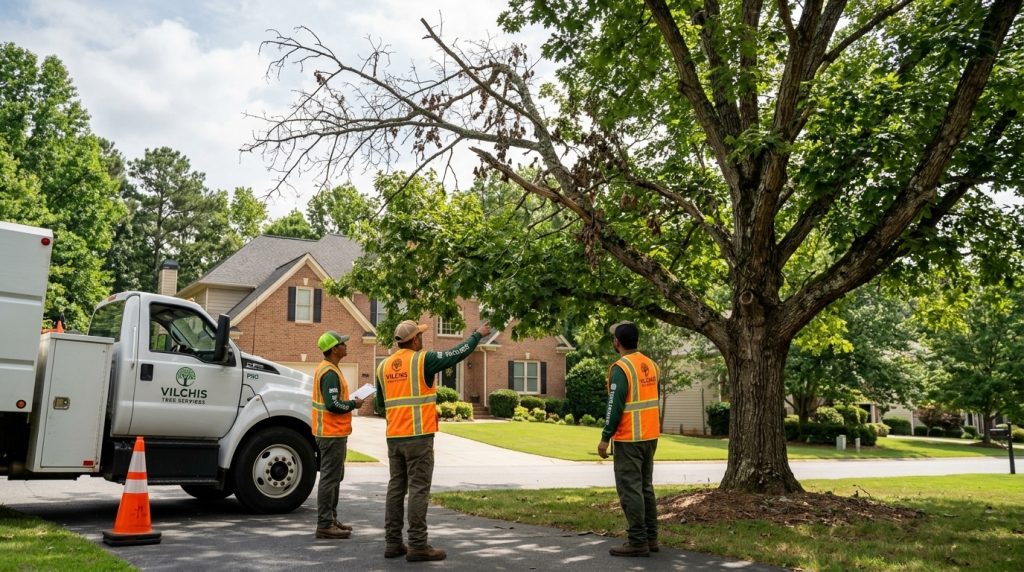
- On-site assessment: The crew evaluates the tree’s condition, lean direction, proximity to structures, access for equipment, and any obstacles (power lines, fences, neighboring structures).
- Plan and equipment selection: Based on the assessment, the crew determines whether the tree can be felled in sections from a climb, requires a crane, or can be directionally felled if open space allows.
- Work zone preparation: Ground protection for lawns (especially important in Kennesaw’s clay soil, which ruts easily under equipment), neighbor notification if work happens near property lines, and coordination with utility companies if lines are involved.
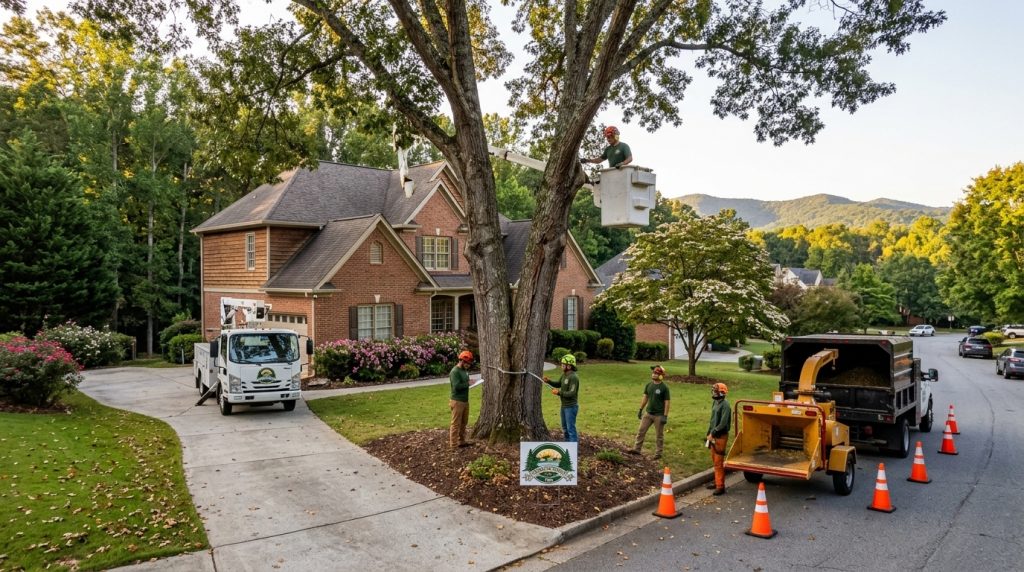
- Removal execution: Sectional removal from top down is most common on Kennesaw residential lots because space is limited. Each section is rigged and lowered, not dropped.
Cleanup and stump decision: All debris is removed. The homeowner decides whether to grind the stump (most common) or leave it for later.